


You have heard real estate investors discussing “Notes”…so what exactly is a Note? How does a Note work? What are the components of a Note? When will I get payments? How does a Note relate to a Mortgage? How are Notes secured by property? If any of these questions have crossed your mind, we recommend you read on to understand more about Notes and how they work!
INTRODUCTION
The term Note is often discussed in real estate circles. Put simply a Note is an IOU from a borrower to pay back a loan. Most people are familiar with home loans from a bank. Associated with these loans is a promise (the Note) to pay a set amount for a certain duration until the original loan is satisfied. Included in this payment is both principle repayment and interest. These Notes are marketable items that can be bought and sold among investors. This article will help you to understand what a Note is and how it relates to borrowers, a mortgage and collateral.
NOTES EXPLAINED
The Note relationship diagram (see below) is an overview of how a Note works in the real estate investment area. If you are interested in Note investing, we highly recommend you review the diagram and the article below.
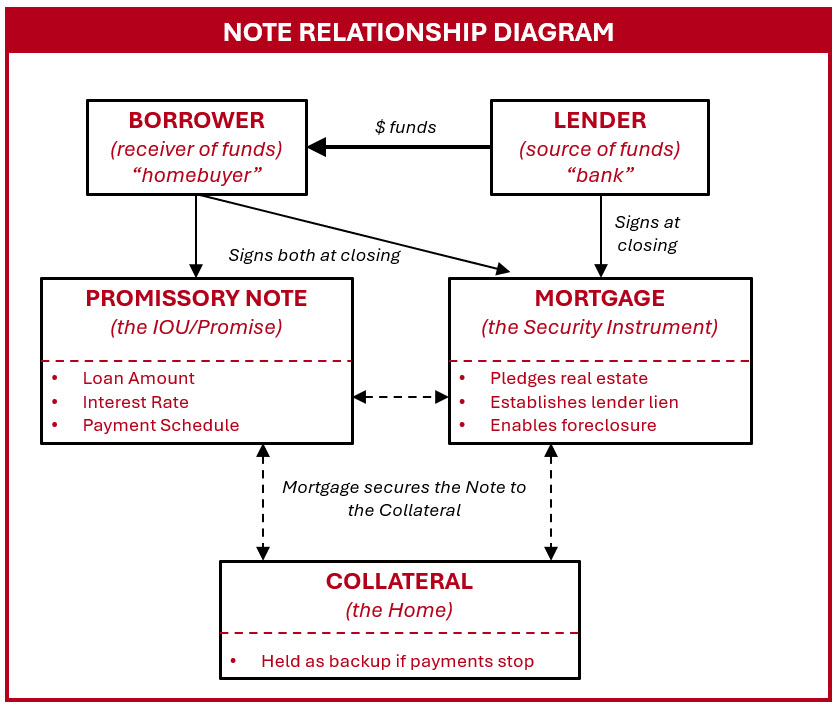
In real estate lingo, a Note (“Promissory Note”) is a legally binding document in which you promise to repay your mortgage loan, with the Note acting as the official “IOU”. While people often use the terms together, a promissory note and a mortgage do two completely different jobs when you buy a home. Here is a quick definition of each block from the diagram above.
Borrower
Borrowers is an entity that is accepting the loan from the lender and is accepting responsibility to repay the loan over a length of time at a set monthly amount. The borrower will sign both the Note (the IOU) and the mortgage (the glue between loan and collateral) at closing. The borrower can be any legal entity, including individuals, couples, groups, and companies. The bottom line is the borrower is making the commitment to repay!
Lender
Lenders are the source of funds in a Note deal. Traditionally, lenders have been thought of as banks or financial institutions, but a lender can be anyone who has funds and is willing to provide funds for the duration of the loan. Lenders will receive a return in the form of interest set at closing. For this return, lenders accept the risk of lending the money. In the event of borrower non-payment, lenders can foreclose and take ownership of the collateral.
Promissory Note
A promissory note is document detailing all elements of the repayment of the loan. The Note is signed by the borrower at closing and is kept by the lender. This original Note is very important. Lenders can sell Notes on secondary financial markets without changing the terms of the loan. The original actual document can be considered legal tender and should be safeguarded. While a Note is an official document and very important, the Note is not required to be recorded.
While there may be some variations, the key elements of a standard promissory note are listed below
- Principal amount: The exact sum of money you borrowed.
- Interest rate: The percentage charged on the loan (fixed or adjustable).
- Repayment schedule: When and where your monthly payments are due.
- Loan term: How long do you have to pay it off (such as 15 or 30 years)
- Late fees: Penalties charged if you pay after the grace period.
- Default rules: What happens if you miss payments, including the lender’s right to demand full repayment.
- (optional) Balloon Payment: This is a special case where borrower agrees to pay off the loan prior to the normal repayment schedule.
Mortgage
The mortgage is the glue that connects the borrower, the Note and the collateral together. The mortgage details how the pieces work together for the life of the loan. The document will clarify the parties involved and define all elements of the full agreement. This is an official document and should be signed and recorded at closing.
Collateral
In real estate, collateral is considered the anchor in any mortgage note deal. The lender will provide an amount upfront for the borrower to use. The lender will then place a lien on the collateral that states if the borrower fails to repay the loan, the lender has the right to seize the collateral (foreclosure). If the borrower continues to make payments, the lender cannot touch the collateral. When the borrower finishes the repayment schedule, the lien will be removed from the collateral.
Type of Collateral can vary but the traditional is a home and the land attached. Other examples of collateral include undeveloped land, developed land, mobile homes and condominiums. If the collateral is some type of real estate, then it can be used as collateral.
SUMMARY
We hope this article has helped to explain what a Note is and how it is connected to the Borrower, Lender, Mortgage and Collateral. Each element is important and has a distinct purpose as shown in the Note Relationship Diagram above. Before jumping into Note investing, make sure to fully understand this relationship and you will be a step closer to your future success with Notes!
CONNECT WITH PEAK NOTES
MEETING
Why not set up a meeting with a Peak Notes specialist to discuss Notes! Meetings are brief, cost nothing and can give you more insight into how you can maximize your investment potential!
If you live in Florida or have a Note in Florida, click on the button below
If you live outside Florida or have a Note outside Florida, click on the button below!
NEWSLETTER
Want to stay informed on everything about Notes? Peak-Notes produces a monthly newsletter that covers information about Notes. The focus is on education and information, really focusing on getting the most out of your investment in Notes. The Newsletter also covers topical news stories, market updates and conference summaries.
If interested, click on the button below!
Have a question about Notes or just want to inquire about Notes?
Click on the button below and send your message or question!